

Learn more about Alison Okuda’s new book
About the book
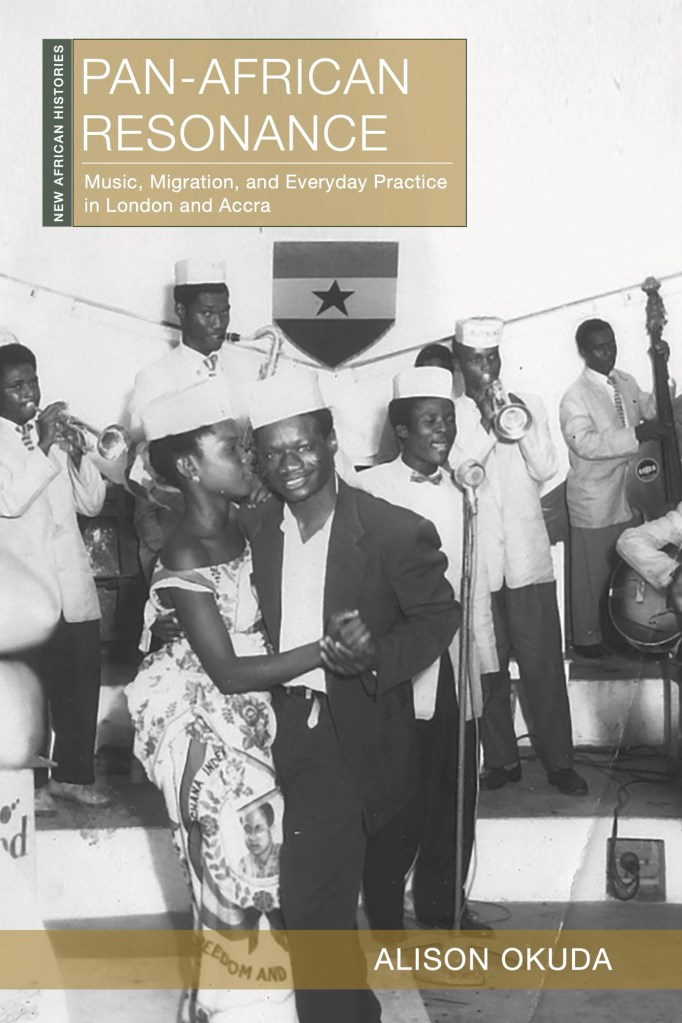
Pan-African Resonance: Music, Migration, and Everyday Practice in London and Accra
(Ohio University Press, 2026)
As African and Caribbean nations gained independence from Britain during the 1950s and 1960s, many young musicians, students, and professionals migrated across the African-Atlantic in pursuit of new opportunities and built new communities. Pan-African Resonance: Music, Migration, and Everyday Practice in London and Accra follows these individuals from nations including Ghana, Trinidad and Tobago, Jamaica, St. Lucia, Barbados, and Guyana on their journeys through music spaces on two continents and across two generations to uncover how they practiced pan-Africanism in their daily lives. Bringing together a wide range of sources, such as musical recordings, newspapers, oral histories, and government documents from seven countries, Alison Okuda argues that pan-African solidarity was sustained through the everyday consumption and creation of popular music.
Pan-African Resonance unfolds in two parts, first showing how the historical convergence of Ghanaian highlife and Trinidadian calypso connected musicians and young members of the independence generation in London and then in Accra. Even where cultural tensions existed, Ghanaian and Caribbean people made their aspirations for freedom and solidarity tangible through various music spaces in London and Accra: nightclubs, recording studios, private homes, and public streets. Before Ghana’s first coup d’état in 1966, Ghanaians and diasporic Africans collaborated to birth an independent African-Atlantic world.
Although the events surrounding 1966 seemed to disrupt Pan-Africanist organizing, Pan-African Resonance illustrates that through the everyday actions of a new generation in London and Accra, the dynamic networks of solidarity crafted through the enjoyment of popular music styles like highlife and reggae in the 1970s still resonated in recordings, on the radio, in live performances, in magazines, and within community organizations.
Influenced by generational change and musical fluidity, African-diasporic unity has remained at the core of popular music, migration, and politics in Ghana and the wider African-Atlantic world into the twenty-first century. Okuda provides a rich methodological approach for readers interested in popular culture, transnational history, interdisciplinary studies, diaspora studies, and modern African history.
Do you have questions about the book?
Are you interested in adopting it for your course?
Would you like to host Dr. Okuda for a book talk?
Are you interested in interviewing Dr. Okuda?
Contact Alison Okuda – aokuda@worcester.edu
Table of contents
Introduction
Part I
1
Music and Migration in African-Atlantic London, 1946-1962
2
Nation Building, Homecoming, and Musical Reverberation in Accra, 1940s-1966
3
Highlife and Calypso: Pan-African Music-Making in Accra, 1950s-1966
Part II
4
Making New Music for a New Generation: Black London, 1962-1980
5
Nation, Gender, and Music in Post-Nkrumah Accra, 1966-1980
6
“African Music on African Land”
Reggae and Accra’s Pan-African Music, 1966-1980
Conclusion
 Alison Okuda, Ph.D.